

Published in Nature: Family of magnetic field-boosted superconductors in rhombohedral graphene
Superconductivity was first discovered in 1911 by Kammerlingh Onnes in Leiden, and a microscopic theory was proposed in 1957 by Bardeen, Cooper and Schrieffer. In this theory, electrons are paired together in a singlet state, with spins pointing in opposite directions. When an external magnetic field is applied, the singlet pairing is easily broken up by the spins aligning with the external field and superconductivity is destroyed. Since then, superconductivity and magnetic fields are know to be largely incompatible, and the critical magnetic field is an important measure of the strength of the superconductor. Crystalline rhombohedral multilayer graphene (RHG) is a promising platform to explore new quantum states of matter due to its superior material quality and gate-tunable strong correlation effects.
In our work, we present a family of three surprising states of superconductivity in 4- or 5-layer rhombohedral graphene, all of which are are able to persist in the presence of strong in-plane magnetic fields up to ~9 T, exceeding the Pauli limit by far more than a factor of 10. In a further surprise, one state is even enhanced by a perpendicular magnetic field. This is in contract to bernal graphene, which showed only relatively weak in-plane enhancement. The two other states are boosted by the in-plane field, and one of them is only created above ~5 Tesla in-plane field. None of these states could be suppressed with the 9 T magnet of this experiment.
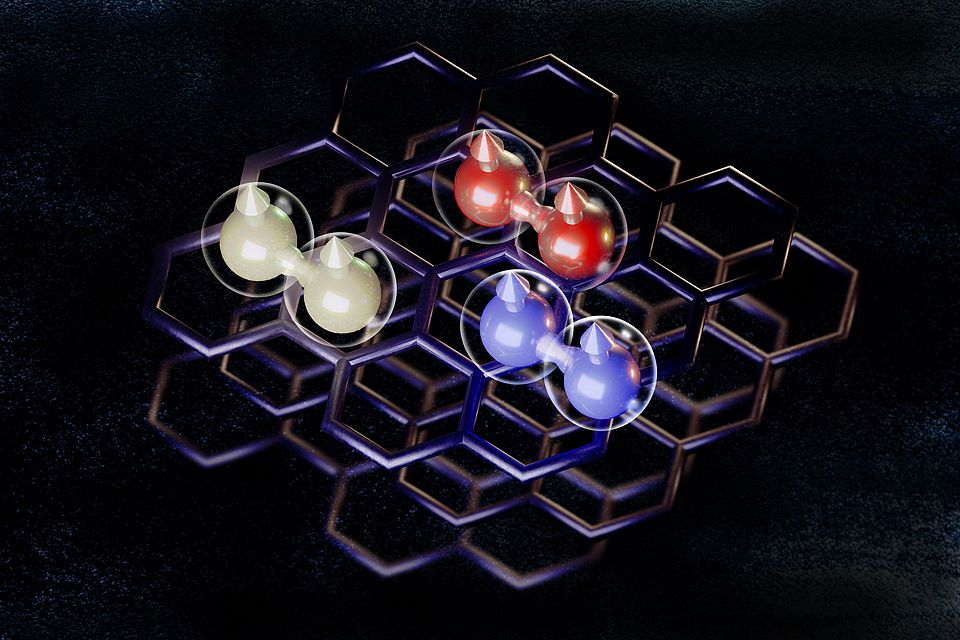
This establishes a new family of unconventional, magnetic field-boosted superconductors in rhombohedral graphene. It is currently still unclear what the microscopic pairing mechanism is. One possible explanation is that the electrons in these states pair differently than in the paradigmatic simple superconductors — for example, with their spins aligned in the same direction in a triplet state. This could make them less sensitive to magnetic fields. The cartoon sketch shows the family of three different states found in the experiment indicated with three different colors (Visualization: Amy Pan, RLE; MIT).
Further, these states reside at relatively low gate electric fields owing to the intrinsically flatter band dispersion — facilitating their study and further engineering. This is paving the way for realizing non-Abelian quasiparticles and topological superconductivity in the extreme clean limit of crystalline graphene.
Collaboration with Long Ju's group (MIT), in-plane magnetic field measurements done in Basel on rhomboheral 4 and 5-layer graphene. Supported in Basel by the Swiss NSF (grant # 215757), the Georg H. Endress Foundation, the WSS research center for molecular quantum science (MolQ) of the Werner Siemens Foundation, the UpQuantVal InterREG, and the EU H2020 MSCA cofund QUSTEC.
Family of magnetic field-boosted superconductors in rhombohedral graphene,
Junseok Seo*, Armel A. Cotten*, Shenyong Ye*, Mingchi Xu, Omid Sharifi Sedeh, Henok Weldeyesus, Tonghang Han, Zhengguang Lu, Zhenghan Wu, Wei Xu, Jixiang Yang, Emily Aitken, Prayoga P. Liong, Phatthanon Pattanakanvijit, Zach Hadjri, Rasul Gazizulin, Kenji Watanabe, Takashi Taniguchi, Mingda Li, Dominik M. Zumbühl+ & Long Ju+, Nature (May 22, 2025), manuscript pdf
News Uni Basel Graphene reveals surprising types of superconducting states
MIT News Graphene can hold multiple states of superconductivity, a new study finds