

On arXiv: In-situ control of hole-spin driving mechanisms
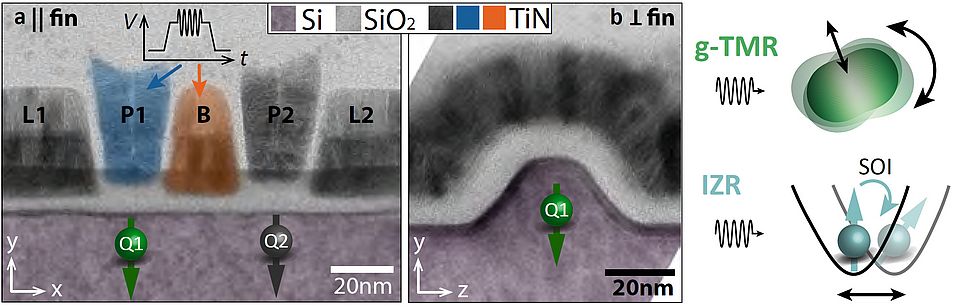
Hole-spin qubits enable fast, all-electrical spin manipulation through electric-dipole spin resonance (EDSR), arising from two microscopic mechanisms rooted in their intrinsically strong spin-orbit interaction. Depending on how the electric field acts on the quantum dot, the spin can be driven either by a modulation of its g-factor or by a displacement of the wave function.
Here, we demonstrate in-situ control over the dominant EDSR driving mechanism of a hole-spin qubit in a silicon fin field-effect transistor by applying microwave signals to two different gate electrodes, thereby tuning the orientation of the local electric field. Our analysis based on a g-matrix formalism allow us to identify the underlying driving processes and track their relative contributions for different drive configurations.
By selecting the drive electrode, we can switch from a regime dominated by g-factor modulation to one with a strong contribution from wave function displacement. This in-situ tunability provides direct experimental access to both spin-driving mechanisms and offers a route toward optimized spin-qubit performance.