

On arXiv: Compact self-matched gyrators using edge magnetoplasmons
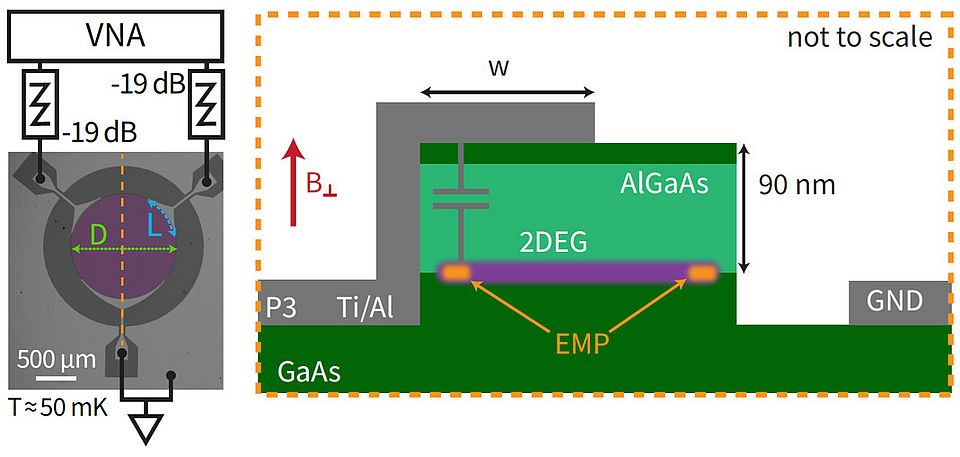
Non-reciprocal microwave components are indispensable in quantum information processing and cryogenic measurement. Conventional implementations, however, are bulky and not scalable. Edge magnetoplasmons (EMPs) provide a chiral platform where broken time-reversal symmetry allows for a non-reciprocal response. Current implementations based on EMPs are suffering from large loss or require bulky impedance matching networks.
In this work, we demonstrate compact, self-impedance-matched gyrators based on edge magnetoplasmons in a GaAs 2D electron gas. Gyrators are the most fundamental non-reciprocal devices which serve as building blocks for other non-reciprocal elements such as isolators and circulators. The self-matching is enforced by a simple choice of the geometry of the capacitive contacts having a length ratio of 1 to 2 with respect to a third grounded terminal, resulting in a loss as low as only 2 dB. This is two orders of magnitude less lossy than previous EMP devices and is already approaching the loss of much bulkier commercial devices. Further, the low loss allows experiments even without a microwave amplifier. Our devices achieve gyration from 0.2 GHz to 2 GHz, tunable by moderate out-of plane magnetic fields below 400 mT, and sub-mm footprint, two orders of magnitude smaller than conventional ferrite-based components.
In addition, we develop a quantitative model providing the fundamental physics of the device in terms of resonant EMP modes and propagation along the gated and ungated sections, allowing us to also extract the respective EMP velocities. The model shows excellent agreement with experiment across device sizes and magnetic fields, enabling the extraction of key physical parameters such as the gate capacitances and microwave loss. Importantly, it provides a framework to quantify dissipation and track its evolution, offering new insight into the coherence of edge excitations in a chiral system. This also suggests a path to even less lossy devices with an improved materials platform.
Gyrators have been proposed as key building blocks for quantum error correction, for instance by enabling bosonic encodings such as Gottesman–Kitaev–Preskill codes to realize self-correcting qubits. In addition, EMP-based devices offer a platform for coupling, driving and entangling semiconductor qubits over long distances [35, 36, 38–40], representing yet another important application. The self-matching design concept is broadly applicable also beyond non-reciprocal applications such as plasmonic transmission lines and resonators.
Collaboration with Stefano Bosco (TU Delft, concept and theory) with experiments done in Basel, supported by the Swiss National Science Foundation trough the NCCR SPIN grant no. 225153 and grant no. 215757, UpQuantVal InterREG, and the Swiss Nanoscience Institute SNI.
Aldo Tarascio, Yiqi Zhao, Rafael S. Eggli, Taras Patlatiuk, Christian Reichl, Werner Wegscheider, Stefano Bosco, and Dominik M. Zumbühl, arXiv:2602.05439, manuscript pdf