

On arXiv: Compact self-matched gyrators using edge magnetoplasmons
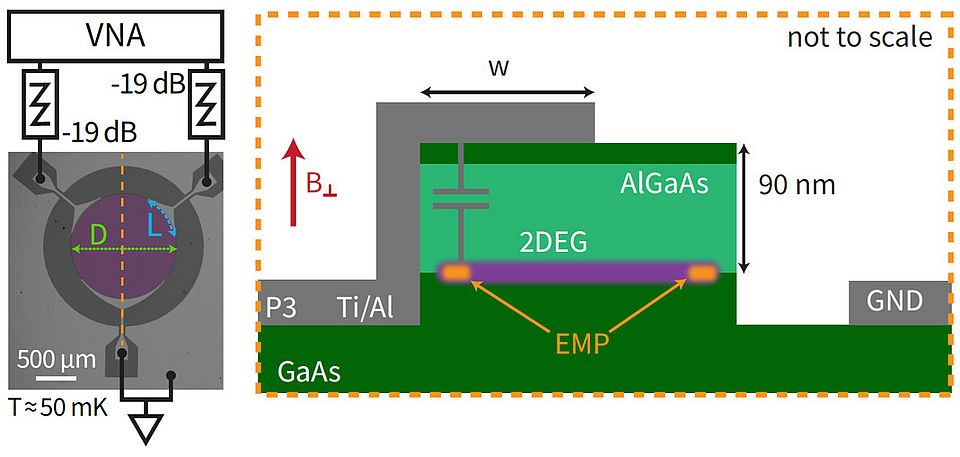
Non-reciprocal microwave components are indispensable in quantum information processing and cryogenic measurement. Conventional implementations, however, are bulky and incompatible with on-chip scalable integration. Recent efforts to develop compact on-chip alternatives often rely on active modulation or complex circuit architectures, which introduce additional losses and degrade performance.
In this work, we demonstrate compact, self-impedance-matched gyrators based on edge magnetoplasmons in a 2D electron gas. Gyrators can be used as building blocks for other non-reciprocal elements such as isolators and circulators. Our devices achieve gyration from 0.2 GHz to 2 GHz, tunable by moderate out-of plane magnetic fields below 400 mT, and sub-mm footprint, two orders of magnitude smaller than conventional ferrite-based components. Using an electrode geometry predicted to minimize reflections, we achieve insertion losses as low as 2 dB to 4 dB. This insertion loss is already approaching that of much bulkier commercial devices, and presents an order of magnitude improvement over devices of comparable size.
The self-matched design framework we utilize is broadly applicable, and can be implemented in a wide variety of non-reciprocal RF devices such as isolators and circulators. Further, it is compatible with future implementations in anomalous Hall materials, offering a path toward magnetic-field-free operation. Finally, self-matched gyrators have been proposed as key elements of error corrected qubits such as grid states as well as coherent long-distance qubit coupling schemes.
Collaboration with Stefano Bosco (TU Delft, concept and theory) with experiments done in Basel, supported by the Swiss National Science Foundation trough the NCCR SPIN grant no. 225153 and grant no. 215757, UpQuantVal InterREG, and the Swiss Nanoscience Institute SNI.
Aldo Tarascio, Yiqi Zhao, Rafael S. Eggli, Taras Patlatiuk, Christian Reichl, Werner Wegscheider, Stefano Bosco, and Dominik M. Zumbühl, arXiv:2602.05439, manuscript pdf