

METRIQ Bridge Quantum launched
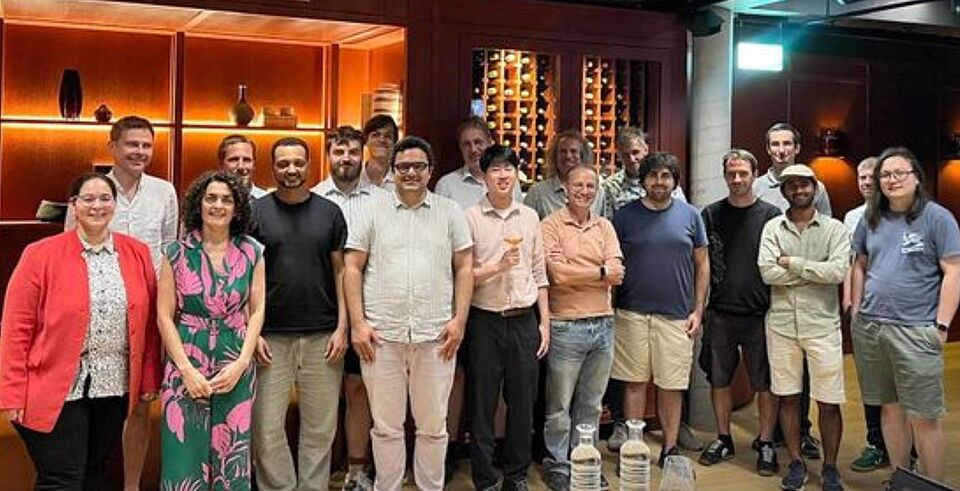
METRIQ Bridge Quantum supported by SNSF/Innosuisse was launched with a kick-off meeting in Bern, bringing together the team from EPFL, FHNW, Uni Basel and implementation partner Basel Precision Instruments.
Thermometry in the millikelvin (mK) regime is a cornerstone of low temperature experiments. Yet below 100 mK, robust and traceable thermometry remains a critical bottleneck. Traditional resistive thermometers (e.g., RuOx, Cernox) suffer from poor thermalization and long time-constants, susceptibility to wiring and EMI artifacts and the resulting degradation of calibration. These limitations restrict accuracy, scalability, and operational robustness; especially since recalibration is impractical and cost inefficient.
Coulomb Blockade Thermometers (CBTs), introduced in the 1990s, offer a robust, primary thermometry alternative. Based on tunnel junction arrays, CBTs measure temperature through a conductance dip near zero bias, without requiring device-specific calibration. They are passive, magnetically and EMI insensitive, and operable in the mK regime. Recent advances have demonstrated on-demand in-situ self-calibrating CBTs, making them promising candidates for field deployment.
The METRIQ consortium aims to transform the CBT thermometry technology into a practical and scalable tool for mK thermometry by addressing key challenges in temperature range coverage, as well as fast, multi-sensor, real-time readout. This will be achieved through a coordinated hardware–software co-design effort, leveraging the consortium’s complementary interdisciplinary expertise: CBT thermometry (Dominik Zumbühl, Uni Basel), cryo-CMOS (Edoardo Charbon, EPFL), embedded instrumentation (Mathieu Coustans, FHNW), and commercial quantum hardware development (Parisa Fallahi, BASPI).
By delivering a scalable, high-resolution CBT readout solution, METRIQ will establish primary mK thermometry as a practical tool for the quantum era, enabling accurate, traceable thermal diagnostics across cryostats, chips, and quantum–classical interfaces.
More info: SNSF page, FHNW press release, BASPI's linked-in post